Independent Verification of The 7^7 Elton Anomaly
Introduction
In this article, I am going to show how I verified the Elton Anomaly and its associated patterns using a King James Bible downloaded from a different source than the files downloaded from KJV Code, the website of Brandon Peterson. You can read a detailed description of the Elton Anomaly here. I provide a bash script with the commands that reproduce the steps I followed.
chmod u+x verify-elton.sh
./verify-elton.sh
If something goes wrong, it will output an error message. Else the console will print the word counts of the Elton Anomaly.
Description
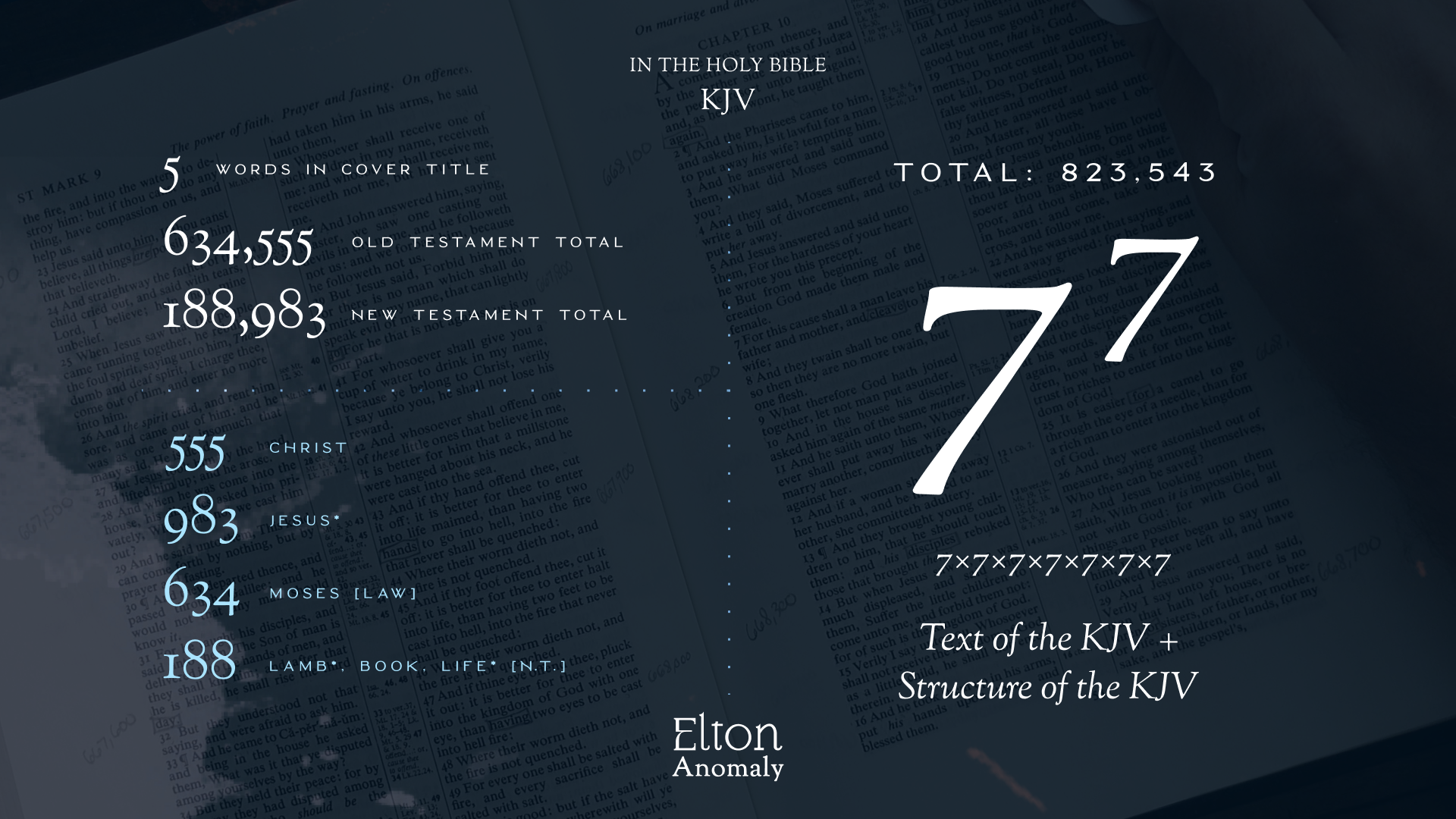
The entire King James Bible consists of 823543 = 77 words and numbers, including the cover, the book titles and all the chapters, verses and words inside. The total count of words and numbers can be counted with the standard wc GNU/Linux command, pasting the following into the terminal:
curl https://kjvcode.com/wp-content/uploads/2024/05/Holy-Bible-King-James-Version-Entire-Bible-Concord.txt | wc -wThis command downloads the TXT file of the KJV and redirects its text to the wc command, which is called with the -w parameter to count the number of words (including number strings) it receives as input. The result is 823543.
I downloaded the KJV from a different source to confirm that it outputs the same word count. I found a TXT version here, however it is not formatted correctly. The text has to be formatted in the same way that printed Bibles are formatted (see the KJV Code article for more details). I did this with a sequence of GNU sed commands. After it was formatted correctly, I used another two sed commands to split into the Old and New Testament, and a head command to extract the Torah from the OT.
If we divide the word count between the Old & New Testament, we have:
- Bible Cover: 5 words
- Old Testament: 634,555 words
- New Testament: 188,983 words
Now for the commands:
cat Holy-Bible-KJV.txt | wc -w
cat OT-KJV.txt | wc -w
cat NT-KJV.txt | wc -w
The output should be 823,543 for the first command. 634,555 for the second, and the third 188,983.
This division is important because:
- The word “Moses” appears 634x in the Torah.
- “Christ” appears 555x times in the Bible.
- We find both “lamb*”1 and “book” 188x each in the Bible and also “life*” 188x in the N.T.
- “Jesus*” is found 983x
In order to confirm if these numbers are correct you can install the program King James Pure Bible Search or go to the web version of the software. However this task can be done without installing any program, with the TXT file of the KJV appropriately formatted, using the command grep, which is a GNU/Linux tool to find patterns in files.
Before using the grep command, the use of the character ! for history expansion needs to be turned off, as it is part of lookbehind/lookahead negative assertions used in regular expressions.
set +HCounting the number of times the word “Christ” appears in the KJV Bible can be done with the command:
grep "(?<![[:alnum:]-])Christ(?![[:alnum:]'’-])" Holy-Bible-KJV.txt -Pio | wc -lIt should output 555.
- The command
grepwith the argument-oprint only the matched parts of a matching line, with each such part on a separate output line. - The first parameter of the grep command is a regular expression which is a sequence of characters that specifies a match pattern in text.
- The argument
-iignore case distinctions in both the pattern and the input files, so that characters that differ only in case match each other. - The argument
-Ptellsgrepthat we are using a Perl regular expression. - The matching lines are redirected to the
wccommand with the-largument, which counts the number of lines.
grep "(?<![[:alnum:]-])Jesus[[:alnum:][:punct:]]*" Holy-Bible-KJV.txt -Pio | wc -lIt should output 983.
grep "(?<![[:alnum:]-])Lamb[[:alnum:][:punct:]]*" Holy-Bible-KJV.txt -Pio | wc -l
grep "(?<![[:alnum:]-])book(?![[:alnum:]'’-])" Holy-Bible-KJV.txt -Po | wc -l
grep "(?<![[:alnum:]-])Life[[:alnum:][:punct:]]*" NT-KJV.txt -Pio | wc -l
The three comands should output 188. In the second command the -i argument has been removed. This is so that the string BOOK used in the titles are not counted.
grep "(?<![[:alnum:]-])Moses(?![[:alnum:]'’-])" Torah-KJV.txt -Po | wc -lThis last command has the Torah TXT as input and the -i option has been removed for the same reason as in the book command. The output is 634.
Conclusion: The Elton Anomaly and its associated patterns are verified in a way that can be reproduced using the GNU/Linux command line and getting the Biblical text from a source other than KJV Code or Pure Bible Search. The grepcommands will produce the same output on the kjvcode.com text as on the formatted holy-bible.online, although the diff command shows that they are not exactly identical in words positioning.
-
* is a wildcard that represent zero or more characters ↩︎